
A denture is a removable dental appliance that replaces missing teeth and the surrounding gum tissue, restoring your ability to chew, speak, and smile. A removable partial denture works the same way but is used when some natural teeth remain, filling the gaps between them. People have used dental prosthetics to replace lost teeth for centuries. Still, today’s dentures rely on digital impressions and acrylic or metal materials for a far more precise, natural-looking fit than earlier versions ever offered.
Dentures & Removable Partials

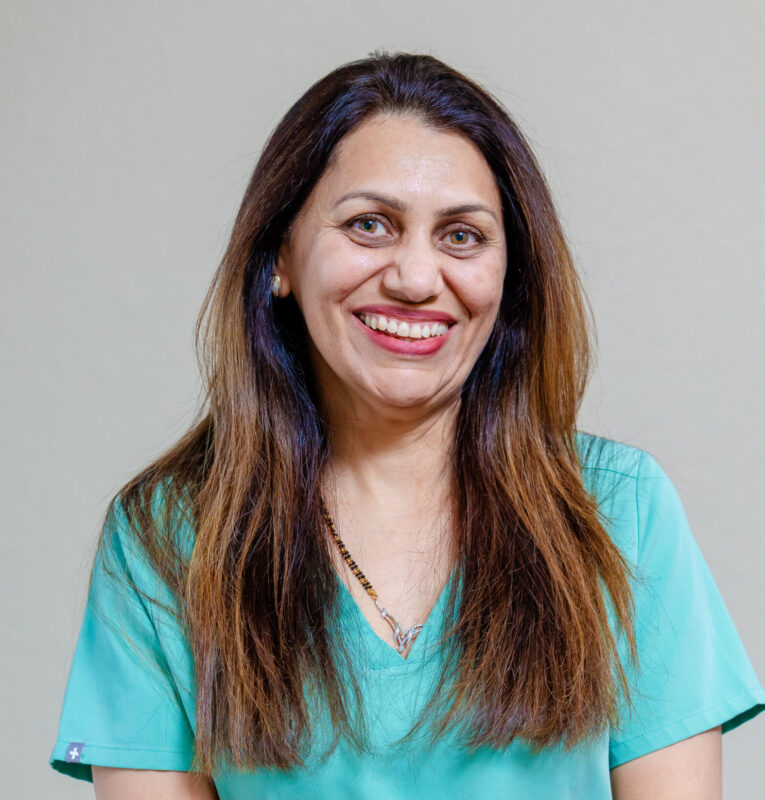
Meet Dr. Dimple Sharma, DDS
Ask Dr. Dimple Sharma what frustrates her most about denture care, and she’ll say it’s patients who assume a loose, uncomfortable fit is just something you live with. That’s the problem she set out to fix when she brought denture and partial care into New Hope Dentist after opening the practice in 2017, building on years of restorative work at dental offices across Texas following her degree from the NYU College of Dentistry.
She now treats patients throughout Cedar Park, Leander, and Liberty Hill, with ongoing coursework focused specifically on denture design and digital fitting technology, so the first version you wear is closer to right than a standard model would be. Dr. Sharma holds an active Texas dental license, listed publicly through the Texas State Board of Dental Examiners, and consults in English, Hindi, or Punjabi, whichever puts you most at ease during the conversation.
What are dentures?
Dentures are custom-made dental appliances used to replace missing teeth and restore essential functions like eating, speaking, and smiling. At New Hope Dentist in Cedar Park, TX, we offer several types of dentures tailored to your needs, whether you’re missing a few teeth or a full arch.
Types of Dentures
- Full Dentures: These replace all the teeth in the upper or lower jaw. Full dentures rest directly on the gums and are typically removable. They’re a great solution for patients with complete tooth loss.
- Partial Dentures: Partial dentures are used when some natural teeth remain. They fill gaps with artificial teeth connected to a metal or acrylic base that clasps onto surrounding teeth for support.
- Implant-Supported Dentures: For added stability, implant-supported dentures attach securely to dental implants placed in the jawbone. These can be fixed or removable and offer a more natural feel with less movement.
- Immediate Dentures: Placed right after tooth extraction, immediate dentures allow you to leave the office with a complete smile. They often require adjustments as your mouth heals.
We’ll help you choose the right option based on your oral health, lifestyle, and goals.
The Benefits
Dentures do more than replace missing teeth—they help restore your ability to speak clearly, chew comfortably, and smile with confidence. A well-made set of dentures supports your facial structure, preventing the sunken appearance that often comes with tooth loss, and helps you enjoy a wider range of foods that contribute to overall health.
In addition to function and aesthetics, dentures are a non-surgical, cost-effective option for many patients. Whether you choose a removable set or implant-supported dentures, today’s options are more comfortable and natural-looking than ever. At New Hope Dentist, your dentures will be custom-designed to fit securely and match your natural smile.
Dentures also relieve the pain and sensitivity caused by damaged or decaying teeth. They restore not just appearance, but comfort—helping you eat properly, speak clearly, and feel more like yourself again.
Signs It Might Be Time For Dentures
If you’ve lost one or two teeth, the idea of getting dentures may seem to be a little much. On the other hand, if your teeth are heavily damaged and you experience cavities or tooth loss on a regular basis, dentures may be the best option. If your teeth aren’t healthy nor in good condition, you can’t chew your food properly. It also creates an environment that allows for rapid bacterial growth.


Prevention & Hygiene Education
Protecting your remaining natural teeth and gum health now can delay or simplify the need for dentures later. Brushing twice daily, flossing around any remaining teeth, and keeping up with routine dental visits all help catch decay, gum disease, or bone loss early. Once you do have a denture or partial, daily cleaning and regular dentist checkups keep it fitting properly as your mouth naturally continues to change.
Popular Home Remedies and DIY Approaches
Vinegar and baking soda soaks are commonly shared online as homemade alternatives to store-bought denture cleaners, and at-home reline kits are marketed as a quick fix for a denture that’s started to feel loose. Both are appealing because they’re inexpensive and available without an appointment. In practice, though, they’re best thought of as short-term stopgaps rather than long-term solutions for fit or hygiene.
Myth Busting
Research on at-home reline kits indicates the fit rarely holds up. A do-it-yourself reline typically lasts only a few weeks to a couple of months, while a professional soft reline done in-office can hold up for one to two years. That gap exists because a dentist takes a precise impression and processes the material under controlled conditions. At the same time, an at-home kit relies on guesswork for both fit and bite alignment. Cleaning solutions like vinegar carry similar limits, since the acidity that helps cut through buildup can also wear down denture material with repeated use over time.

How We Restore Your Smile with Dentures & Removable Partials
Evaluating Your Mouth and Denture Needs
Dr. Sharma starts with a full exam of your gums, remaining teeth, and jaw structure to understand what you’re working with. She reviews your medical and dental history alongside your goals for chewing, speaking, and appearance. This visit determines whether a full denture, a removable partial, or an implant-supported option fits your situation best. You’ll leave with a clear sense of your options before anything is decided.
Selecting the Right Type of Denture for You
Once we understand your needs, Dr. Sharma helps you choose between materials and designs based on your remaining teeth, gum health, and daily habits. Factors like whether you want a metal-framed partial or a more flexible option all shape this decision. She walks you through the trade-offs in plain language. This step ensures your final denture matches both your mouth and your lifestyle.
Taking Impressions and Crafting Your Custom Denture
Digital impressions capture the exact shape of your gums and any remaining teeth, without the mess of traditional molds. These impressions are sent to a trusted dental lab, where your denture or partial is custom-built to match your bite and natural tooth shade. This process typically takes a couple of weeks. You’ll be kept updated throughout so there are no surprises.
Fitting, Adjusting, and Finalizing Your Denture
When your denture arrives, Dr. Sharma checks it carefully against your gums, bite, and speech before you leave the office. Small adjustments to the fit or shape happen right there in the chair. She’ll show you how to insert and remove it properly. Most patients need a short adjustment period as their mouth and tongue get used to the new appliance.
Long-Term Check-Ins and Denture Adjustments
Your mouth continues to change even after your denture is placed, so we schedule follow-up visits to monitor fit and comfort. Relines or small adjustments are common as gum tissue and bone naturally shift over time. Dr. Sharma recommends routine checkups to catch these changes early. This ongoing attention keeps your denture comfortable and functional for years.
Cost & Insurance
Replacing missing teeth with a denture or partial is one of the more financially manageable restorative options available, and dental insurance often helps cover part of the cost. The figures below reflect general industry averages, not a quote for your specific treatment at New Hope Dentist.
Industry Average Pricing
Recent industry pricing data puts the average cost of a full denture at around $1,800, with partial dentures averaging closer to $1,500. However, your exact cost depends on the materials chosen and any preparatory work needed. These numbers are national averages only. If you’d like to learn how New Hope Dentist has worked to make dentures more accessible than many practices, or want your exact rate, please contact our team directly.
Common Insurance Providers
Current insurance industry rankings name Denali Dental, Delta Dental, and Spirit Dental among the top dental insurance providers of 2026, alongside carriers like Guardian and Ameritas that also offer meaningful coverage for major restorative work. This list reflects general industry standing and isn’t a guarantee of what New Hope Dentist accepts or what your specific plan covers. To verify whether we accept your insurance or preferred payment method, please speak with a member of our team.
Talk to Someone Who Actually Fits Dentures for a Living
A denture that constantly needs repositioning isn’t doing its job, no matter how many times you’ve learned to work around it. Dr. Dimple Sharma has spent years refitting patients across Cedar Park who came in convinced their denture was “close enough,” and left with one that actually wasn’t. Reach New Hope Dentist at 512.259.6577 to get on the calendar, and if you’d rather see real patients’ results first, we’re on Facebook, Instagram, and X.
FAQs
If you have dentures, do you still need to have dental checkups with your dentist?
Dr. Sharma recommends visiting the dentist every one or two years, even if you have dentures. Regular dental checkups allow her to monitor the health of your gums and other soft tissues in your mouth. She can also check how well your dentures fit and adjust them if they’re causing lesions or blisters to form on your gums.
Dentures must also be properly maintained. Dr. Sharma will check them regularly to determine if it’s time for them to be relined or adjusted in any way. Dentures need to be relined every five years or so to maintain proper fit and prevent them from slipping as you chew or speak.
How much do dentures cost?
Denture costs vary depending on whether you need a full or partial denture and the materials used to make it. Full dentures tend to cost more than partials since they replace an entire arch of teeth rather than a few. Many dental insurance plans help cover part of the expense, and our team can review your specific benefits. We recommend scheduling a consultation so we can give you an accurate, personalized estimate.
What are dentures made of?
Dentures are typically made from acrylic resin, metal, or a combination of both. The pink base that looks like gum tissue is usually acrylic, while the replacement teeth are made of durable acrylic or porcelain. Some partial dentures may also include a lightweight metal framework for added strength and support.
How to care for dentures?
Handle your dentures gently and keep them moist whenever they’re out of your mouth, since drying out can cause warping. Rinse them after meals to remove food particles, and take them out overnight to give your gums a rest. Avoid using hot water, which can distort the material, and visit Dr. Sharma regularly so she can check the fit as your mouth naturally changes.
How to clean dentures?
Brush your dentures daily with a soft-bristled brush and a non-abrasive cleanser made specifically for dentures, since regular toothpaste can be too rough on the material. Soak them in a denture-cleaning solution or plain water overnight to keep them from drying out. Rinse thoroughly before placing them back in your mouth each morning, and avoid using toothpicks while wearing a partial.
Can you eat with partial dentures?
Yes, partial dentures are designed to help you chew a wide variety of foods once your mouth adjusts to wearing them. It’s best to start with softer foods cut into smaller pieces and chew evenly on both sides of your mouth during the first few weeks. Some initial difficulty chewing or speaking is normal as your tongue and cheeks adapt. Most patients return to eating their usual foods comfortably within a short adjustment period.
What do partial dentures look like?
Partial dentures include artificial teeth attached to a base that matches your natural gum color, along with small metal or acrylic clasps that hook around your remaining teeth for support. Some designs use more natural-looking connectors instead of visible metal clasps, depending on your preference. From a normal conversational distance, a well-made partial blends in naturally with the rest of your smile. Most people won’t notice you’re wearing one unless you tell them.
Can you get partial dentures with no back teeth?
Yes, a removable partial can be designed to replace missing back teeth, restoring your ability to chew evenly on both sides of your mouth. Leaving back teeth unreplaced can gradually shift your bite and put extra strain on your remaining teeth over time. Dr. Sharma can evaluate your mouth and recommend a partial that is built to restore that balance. In some cases, an implant-supported option may also be worth discussing if you want added stability.
How long do dentures last?
Most dentures last between 5 to 10 years with proper care. Over time, natural changes in your mouth and everyday wear can affect how they fit and function. Regular dental checkups help ensure your dentures stay comfortable and effective and let you know when it’s time for a replacement.